Houdini's 1926 Death in Detroit Haunts the City a Century Later
The magician died on Halloween after ignoring medical advice to rest, and his legacy continues to draw crowds to a museum in western Michigan.
By Olivia Grant ·
The magician Harry Houdini could not escape the fate that caught him in Detroit on October 31, 1926. Exactly one century later, his death continues to draw attention to the Motor City and the circumstances surrounding his final days.
Houdini performed in Detroit 19 times between 1894 and 1926. He built his fame by escaping from handcuffs and jail cells, often from the tops of office buildings to ensure local newspapers reported on his next stage shows. In 1906, he jumped from the Belle Isle Bridge into the river below while bound in two sets of police handcuffs. Reports from the time noted the river was not frozen, though later movies portrayed the escape as a dive through an ice hole.
By 1914, Houdini had introduced the Water Torture Cell, a coffin-sized box filled with water. He was lowered in headfirst with his ankles and the top locked. Dorothy Young, who toured with Houdini as a stage assistant at age 17, recalled the tension of the act in a 2004 interview. "Mrs. [Houdini] always stood in the wings because they had a secret code in case he couldn't get out," Young said.
Houdini's final illness began in Montreal just before his Detroit tour. He accepted a challenge from a college wrestler to withstand blows to his stomach. The wrestler punched him several times before Houdini could tighten his muscles. Young noted that the boys did not give him a chance to protect himself. Doctors advised Houdini to rest, but he refused to cancel his scheduled Detroit shows due to financial pressure to fulfill his contract.
Jeremy Dimick, a curator at the Detroit Historical Museum, stated that Houdini only made it through one performance. He lacked the strength to apply makeup and collapsed during intermissions. Houdini was carried from the Garrick Theater to his hotel and then to Grace Hospital, where doctors found a ruptured appendix. He underwent two surgeries and died on Halloween.
The physical locations tied to Houdini's death have since disappeared. The Garrick Theater, his hotel, and Grace Hospital are gone. The Hamilton Funeral Home that embalmed him became a girls' art school, which later shut its doors. In 2004, the then-head of the school, Juanita Hammond, showed visitors a locked storage area with an indented floor used to drain fluids from corpses. "Houdini was laid out here by the Hamilton Funeral Home, in this room here," Hammond said.
Houdini's wife, Bess, held séances for a decade after his death, seeking contact with her husband. At a séance on Halloween ten years later, she said good night to him. She later appeared in a movie cameo, stating that if it had been possible for the dead to return, she would have received a sign in the past ten years.
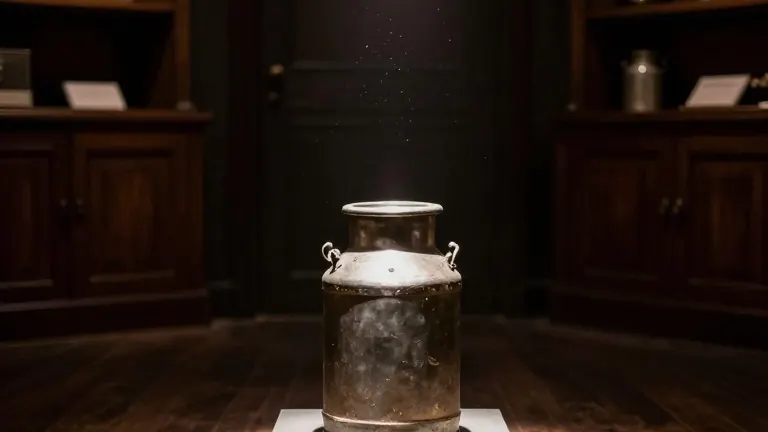
At the American Museum of Magic in Marshall, Mich., about 100 miles west of Detroit, John Sherwood is orchestrating a séance for the centennial. He uses an aged metal can from Houdini's workshop, known as the milk can. Houdini would jump into the can filled with warm water while locked with six Mastodon locks. He would escape backstage and read a newspaper while the audience waited, emerging only after his assistants splashed him with water.
Sherwood said some séances have placed a lox and bagel sandwich in the milk can, appealing to Houdini's Jewish heritage to invite his spirit to take a bite. Conspiracy theories persist regarding his death, including whether his death certificate was altered to show a Halloween date or if the wrestler was a hitman sent by angry psychics. Sherwood believes the centennial might be the perfect time for the magician to appear, citing Houdini's love of showmanship.
Source: WUSF Public Media