Dark Matter Search: LUX-ZEPLIN Records Unexplained Particle Event
UT physicist Katherine Freese says the underground detector’s recent reading fits the profile of a Higgsino, a particle linked to the Higgs boson.
By Olivia Grant ·
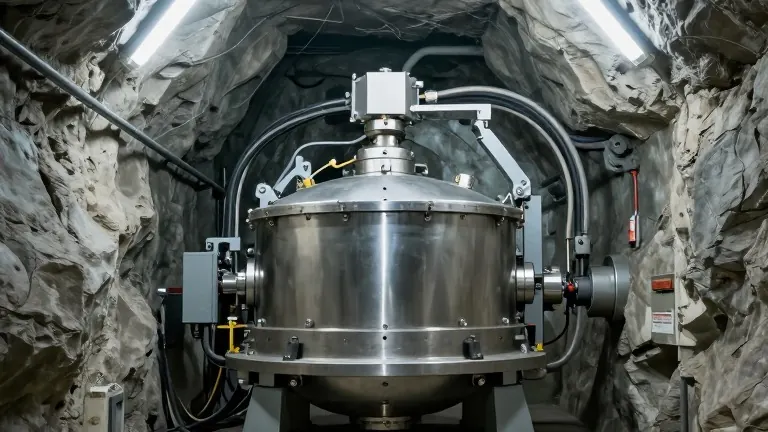
Katherine Freese, director of the Weinberg Institute for Theoretical Physics at the University of Texas at Austin, has proposed a specific identity for a mysterious signal recorded by the LUX-ZEPLIN experiment. The underground detector in South Dakota recently registered a single particle interaction that does not match known background noise or electron recoils. Freese and her student, Dionysios Theodosopoulos, published a paper within 24 hours of the announcement suggesting the event may be a Higgsino.
The Higgsino is a theoretical supersymmetric partner of the Higgs boson, the particle discovered in 2012 that provides mass to other known particles. Freese stated that the Higgsino hypothesis offers a perfect fit to the data collected by the detector. While the single event is not yet sufficient to claim a full discovery, it provides new momentum to a search that has spanned decades. The finding aligns with Freese’s earlier work on how underground detectors could spot dark matter.
The LUX-ZEPLIN experiment is situated in an abandoned gold mine in South Dakota. The detector contains 7 tons of xenon and is designed to isolate weak interactions from electromagnetic interference. Scott Kravitz, an assistant professor of physics at UT, served as the analysis coordinator for the experiment during the search. The recorded event stands out because it is not explained by expected junk signals or standard background activity.
Context for the search dates back to the 1930s, when astronomers observed galaxies moving too fast to be held by the gravity of visible matter alone. That discrepancy led to the hypothesis of dark matter. Today, scientists estimate that ordinary matter makes up only about 5% of the universe’s total matter. Dark matter accounts for approximately 25% and acts as a gravitational glue holding galaxies together. The remaining 70% is dark energy, which drives the universe’s accelerating expansion.
Freese has worked on this problem for 40 years, including predictions for Weakly Interacting Massive Particles, or WIMPs. She noted that billions of these particles pass through the human body every second. The team is also developing a new approach called paleo detectors, which involves analyzing rocks that have sat deep underground for a billion years. These rocks may have collected tracks from dark matter particles, offering a way to replace large liquid detectors with long periods of natural collection time.
Source: UT Austin News