Icebreakers fail to clear Vilkitsky Strait, forcing tankers onto alternate routes
Sanctioned Russian vessels stalled for two weeks in the Arctic, exposing logistical gaps in the Northern Sea Route despite record cargo volumes.
By Olivia Grant ·
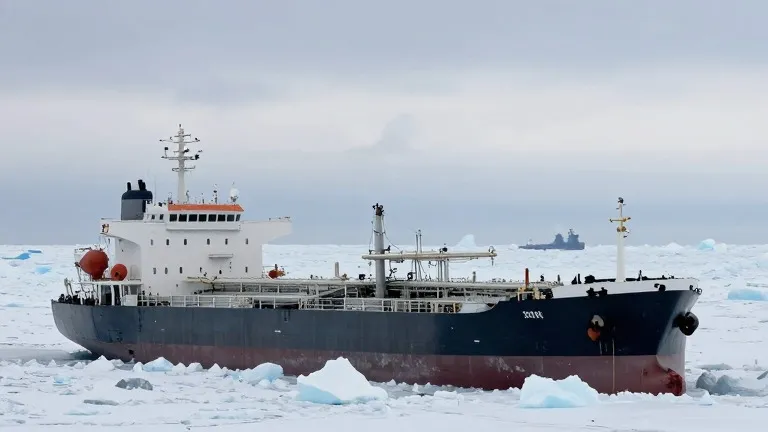
Sanctioned Russian tankers spent up to two weeks stranded in the Vilkitsky Strait this July after becoming trapped in ice. The vessels were positioned in a 55-kilometer-wide choke point between the northern Siberian coast and Bolshevik Island, a key segment of the Northern Sea Route to China.
Two nuclear-powered icebreakers were stationed several days away from the blocked ships. Only one tanker successfully navigated the strait during the incident. The remaining vessels could not pass through the frozen corridor despite the support of the icebreaker fleet.
The stranded tankers eventually diverted to a different route to complete their journeys. This delay contradicts the Kremlin's recent push to present the Arctic passage as a secure and open alternative to southern shipping lanes. The route offers a path farther from Ukrainian drone strikes and potential European naval checkpoints.
President Vladimir Putin described the Northern Sea Route as a reliable path to major global markets. Speaking at the launch of the Vostok Oil project on the Taimyr Peninsula last month, he cited 2025 figures showing 37 million tons of cargo moved along the route. He predicted this volume would almost double by 2030, a target that follows an earlier 2019 goal of 80 million tons by 2024.
Independent data suggests the current trade flow remains modest relative to Russia's total exports. The Norway-funded Center for High North Logistics reported that Russia shipped approximately 2 million tons of crude oil, or 15 million barrels, along the entire route by the end of September. Reuters data indicated the total reached about 20 million barrels by mid-October.
This volume represents a 50 percent increase over 2025 levels but accounts for only about 1 percent of Russia's seaborne oil exports. Tomas Alexa, a senior analyst at the maritime security consultancy Ambrey, characterized the growth as a surge from a relatively low base. He noted that Western sanctions restrict Russia's ability to build and maintain Arctic-capable vessels.
Sanctions also complicate maintenance and repairs. Alexa explained that spare parts and construction materials must often be routed through third parties. Repair services previously provided by Norwegian, Danish, and Dutch firms are no longer accessible to Russian operators. These logistical hurdles limit the fleet's readiness for Arctic conditions.
Other nations are beginning to test the route's viability. South Korea reported on October 22 that its first container ship had used the Northern Sea Route. Officials cited the path as a shortcut to Europe but acknowledged difficult conditions, including large ice floes in the Bering and Vilkitsky straits. China also operated a scheduled container service to Europe along the route for the first time this year.
Ksenia Vakhrusheva, head of the Arctic project at the Bellona environmental group, stated that less ice does not equate to easier navigation. She explained that melting ice can break up and pack tightly in narrow straits, blocking ships that lack ice class certification. She warned that oil degrades slowly in cold conditions and can spread over ice, potentially accelerating climate change effects.
Catherine Sendak of the Center for European Policy Analysis noted that Russia views much of the Arctic as an inner waterway. She said questions remain regarding potential tolls and services Moscow might offer to commercial vessels. Security concerns are rising as the EU outlines a new Arctic strategy and NATO expands its Arctic Sentry mission.
Source: RFE/RL
More Business · World news · Business Complaints · Report a business · Got a Story?