Voters Face Choice Between Collective Governance and Incumbent Power
Serbia’s Sunday election pits the Student List, a non-hierarchical group of professionals, against Aleksandar Vučić, who is seeking to return as prime minister.
By Petra Garnier ·
Serbian voters go to the polls on Sunday to decide between two distinct models of governance. One option is a collective leadership formed by student assemblies. The other is Aleksandar Vučić, the country's long-serving leader who has shifted from the presidency to run for prime minister. Analysts predict a tight race, though reliable polling data remains limited.
The Student List emerged from nearly two years of anti-corruption demonstrations. Protests began after 16 people died when a canopy collapsed at a railway station in Novi Sad. University faculty groups selected 250 candidates rather than holding internal primaries. Ilija Srdanović, a cardiologist and professor at Novi Sad University, tops the ballot. He described his role as supporting a fair struggle, noting that he arrived for an interview on a motorbike in a jacket bearing pro-student slogans.
The group operates without a formal hierarchy or nominated leader. Srdanović is the first name on the list but is not the designated head of the movement. If the group wins, he is not automatically the first choice for prime minister. The candidate roster includes academics, athletes, economists, and engineers who lack prior political experience. Aleksandra, a student at Novi Sad University, identified this professional background as a key strength of the slate.
Vučić has held senior executive roles since 2012. He called a snap election last month and stepped down as president to campaign for the prime ministerial post. Supporters view him as a strong leader who has defended national interests and driven economic growth. He has characterized the student movement as foreign-backed and intent on destabilizing the state.
Critics argue that Vučić’s Serbian Progressive Party controls state institutions and media. An international observation mission cited bias in media coverage and misuse of public resources after the 2023 vote. A pro-government camp has occupied a central Belgrade park for 18 months, where residents have attacked journalists. Vučić has called the camp a symbol of resistance.
The Novi Sad disaster remains a central issue for the opposition. The station renovation was part of a high-speed rail link to Budapest, a project associated with Vučić. Magda Anastasijevic, an analyst at ACLED, noted that Vučić usually finds scapegoats for crises but did not do so for the canopy collapse. Foreign policy also factors into the campaign, as Serbia balances EU accession talks with ties to Russia and China.
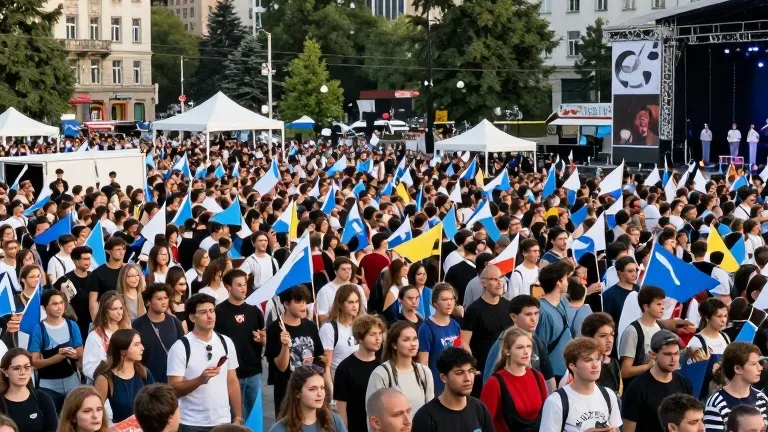
Closing rallies highlighted the structural differences between the two camps. The ruling party held an event at Belgrade Arena featuring only Vučić as a speaker. A reported 150,000 people gathered in Slavija Square to hear from students and candidates. The outcome will determine whether Serbia continues with a single strong leader or transitions to a collective approach.
Source: BBC News