3 Halley Debris Meteors Captured Over Georgia
A composite image from Toccoa shows three bright trails from the Orionid shower before the annual peak.
By Olivia Grant ·
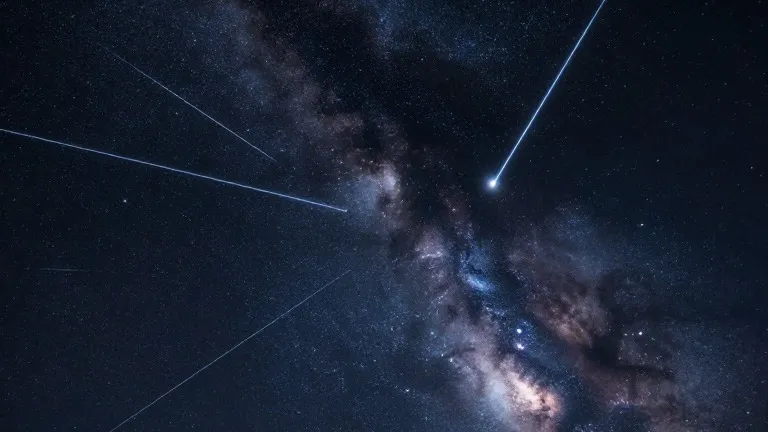
A camera in Toccoa, Georgia, recorded three distinct meteors from the Orionid shower early Tuesday morning.
Astrophotographer Tim McCollum captured the images between 3 a.m. and 4 a.m. on Oct. 21. The meteors are fragments shed by Comet 1P/Halley, which currently sits more than 3 billion miles from Earth. Despite the distance, the dust particles left in the comet's wake burned up in the atmosphere to create glowing trails.
McCollum used a Canon EOS Ra camera paired with an RF 28-70 f2.0 lens. He took multiple 30-second exposures while a star tracker kept the equipment aimed at the shower's radiant. That point of origin lies near Betelgeuse, a red giant star in the constellation Orion. He merged the individual frames into a single composite using PixInsight software.
The final image shows the three meteors radiating away from the shower's center. The background features the stars of Orion's Belt and the glow of the Orion Nebula. The Rosette Nebula, designated Caldwell 49, also appears within the dense starfield of the Milky Way's galactic plane.
The annual display will reach its highest activity in the coming days. The shower remains active through Nov. 7, providing additional nights for observers to view the debris. Earth is also currently passing through streams from Comet 2P/Encke, which generate the Taurid meteor shower.
The Taurid stream can occasionally produce bright objects known as Halloween Fireballs. McCollum's work adds to the record of the current season before the peak arrives. The composite image is part of a collection of astrophotography submitted to Space.com.
Source: Space.com