Griffin-1 Lander Survives 455-Kilometer Vibration Trial at JPL
Voyager Technologies' commercial lunar craft passed final environmental tests at NASA's Jet Propulsion Laboratory, clearing the path for a launch later this year.
By Giovanni Serrano ·
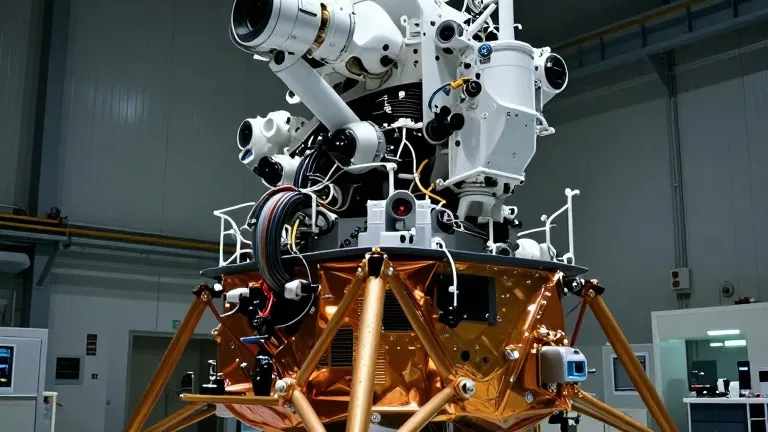
Voyager Technologies' Griffin-1 lander has completed the final set of environmental trials at NASA's Jet Propulsion Laboratory, resolving the last major engineering hurdles before its scheduled launch later this year. The tests, conducted in Southern California, subjected the spacecraft to the extreme thermal, vibrational, and acoustic stresses it will encounter during transit to the lunar south pole.
JPL confirmed that the vehicle passed all required checks, with an image from August 31 showing the lander inside the laboratory's 7.6-meter wide space simulator. This verification process is a standard requirement for commercial payloads seeking to fly under NASA's Commercial Lunar Payload Services program.
The mission profile includes delivering more than 455 kilograms of cargo to a landing site near the moon's south pole. The payload consists of scientific experiments and new hardware designed for surface testing. A key component is Astrolab's FLIP rover, which will operate on the terrain while carrying a high-performance supercomputer.
Charles Whetsel, manager of the Exploration Systems Development Office at JPL, stated that the facility has tested robotic explorers since the Ranger program of the mid-1960s. He noted that the laboratory is providing its expertise to support this new phase of commercial lunar exploration, linking current operations to the historical mission that first provided close-up views of the lunar surface.
The Griffin-1 flight is part of a larger strategic effort to establish infrastructure for a future crewed moon base. NASA aims to construct such a base near the lunar south pole within the next five years. The data collected from the lander's surface operations will inform the engineering and logistical requirements for that long-term human presence.
Source: Space.com