Hebron Residents Face Eviction as Israeli Army Launches Sweeping Demolition Campaign
Military officials confirm a multi day offensive that has already forced hundreds of families from their homes ahead of the upcoming general election.
By Giovanni Serrano ·
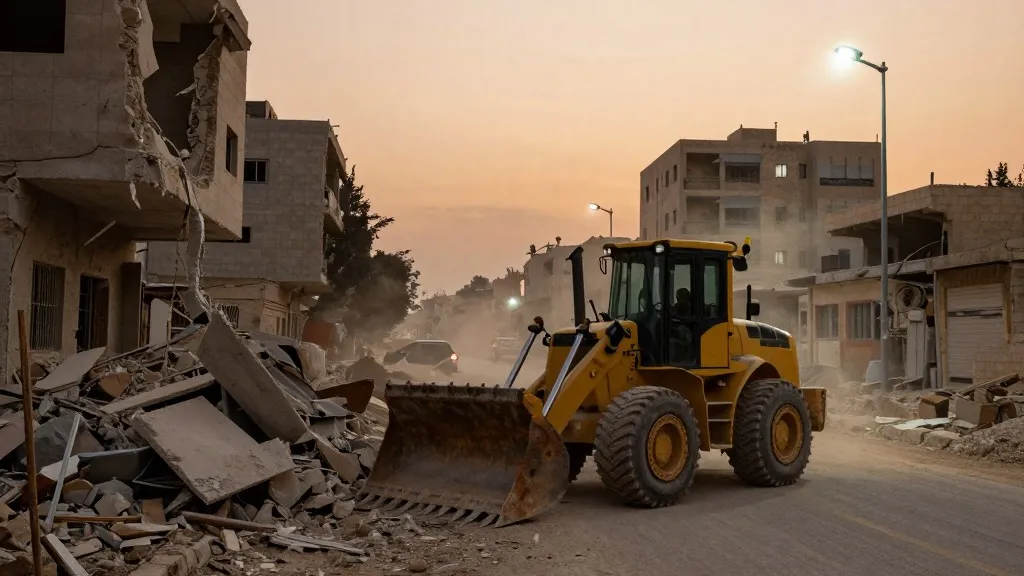
For the residents of Hebron, the daily routine of navigating a divided city has been upended by heavy machinery and sudden orders to leave. In a move that has left thousands without shelter or access to their belongings, the Israeli military has initiated a broad offensive in the West Bank city. Local authorities report that hundreds of families have been displaced from their homes and places of work as bulldozers tear through established neighborhoods. The visual evidence circulating on social media depicts entire streets reduced to rubble, signaling a significant shift in the physical landscape of the urban area.
The scale of the operation has resulted in a tight seal on the city, restricting the movement of its approximately 200,000 inhabitants. While the Israel Defense Forces have not yet provided a detailed public explanation, their statement on social media indicates that dozens of specific targets have been identified across the region. Officials confirmed that these operations are expected to persist for several days, leaving residents in a state of uncertainty regarding when normalcy might return.
Prime Minister Benjamin Netanyahu formally announced the campaign on Friday following a deadly incident at a security checkpoint. Two Israeli soldiers were killed and three others injured when two Palestinian gunmen opened fire. Both attackers were neutralized during the confrontation. In response, the Prime Minister declared that structures near the attack site, as well as the districts where the gunmen originated, would be targeted for destruction. This decision aligns with a long standing practice in the West Bank where homes of suspected assailants are demolished, a policy that has frequently drawn criticism from rights organizations for functioning as collective punishment.
Netanyahu framed the current actions as part of a broader pattern, comparing the Hebron offensive to previous military campaigns in northern refugee camps. During those earlier operations in 2025, hundreds of residences were destroyed, leading to the displacement of tens of thousands of people. The Prime Minister stated that the goal was to clear out weapons and dismantle what he described as terrorist infrastructure, a narrative he reinforced by posting videos from the scene while wearing protective gear.
City officials provide a granular view of the impact on the ground. Mayor Youssef al-Jaabari indicated that the destruction is concentrated in the Ein Deir Baha and Farsh al-Hawa neighborhoods. He noted that the damage extends beyond private residences to include commercial establishments, industrial zones, and critical infrastructure. According to the Mayor, dozens of families were forced to spend the night in the open, with some being instructed to depart without their cars. Spray paint marks on houses serve as indicators for structures slated for demolition. He estimates the military aims to displace 2,500 individuals from a compact urban area of roughly 0.35 square kilometers, while the city governor and deputy mayor confirm that at least 200 families have already been displaced.
The timing of the offensive has raised questions about its political motivations, as it coincides with the final stretch of the general election campaign. Netanyahu, whose campaign platform emphasizes security, suspended his party’s scheduled events on Friday morning to personally oversee the operations. He also revealed that he had reviewed plans for the most substantial military action in the West Bank since 1967, though he did not specify when those broader plans might be executed. It remains unclear if the current Hebron operations are a precursor to that larger initiative or a standalone response to the recent attack.
In a recent interview, Netanyahu hinted at further developments, warning the Palestinian Authority of a significant surprise. The Authority has called for immediate international intervention, arguing that simple condemnation is insufficient to halt the forced displacement of residents. Within the Israeli cabinet, voices have grown louder in calling for a more aggressive approach. Finance Minister Bezalel Smotrich advocated for a campaign in the West Bank similar to those conducted in Gaza and Lebanon, while National Security Minister Itamar Ben Gvir pushed for the complete dismantling of the Palestinian Authority.
Local leaders in Hebron are scrutinizing the timing of these events. Mayor al-Jaabari suggested that the operation is heavily influenced by the approaching election, noting that political figures are seeking to appeal to far right voters and the settler population. As the military continues its work, the city grapples with the immediate consequences of a strategy that blends security objectives with political signaling, leaving thousands of residents to navigate a changed environment with limited resources and no clear timeline for restoration.
Source: BBC News