Kyiv Death Toll Hits 140 as Shelter Shortage Forces Millions Underground
With only enough bunkers for a fraction of the population, 4 million residents rely on metro stations for survival as strikes intensify.
By Olivia Grant ·
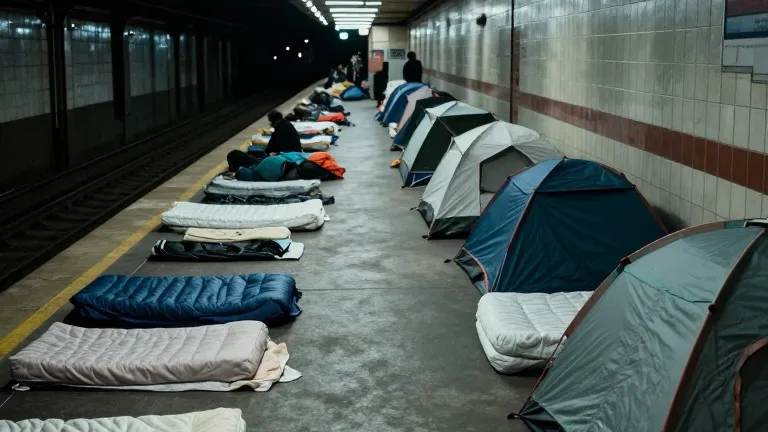
Kyiv’s military administration reports that 140 residents died in the capital during the first eight months of 2026. That figure already exceeds the 172 deaths recorded for the entire previous year. If the current pace continues, 2026 will become the deadliest year for the city since the full-scale invasion began in 2022.
The rising toll correlates with a structural deficit in protective infrastructure. The city lacks sufficient purpose-built shelters for its 4 million inhabitants. Consequently, subway stations have converted into makeshift dormitories. As night falls, residents lay out mattresses and erect small tents along the cold walls. Children sleep beside adults, and pets settle among strangers.
Halyna, a resident of the Lukyanivka district, takes her five-year-old son, Roman, to the nearest station most evenings. She often descends into the metro without a siren because Russia has targeted the district repeatedly over the last four and a half years. Holding her son, she told Deutsche Welle, "We're alive. We've been lucky once again."
The strikes have claimed young lives in central districts. In September, a Russian drone hit an apartment building in Pechersk. Fourteen-year-old Daniel Umanskyj was doing homework in his room when the impact occurred. Vlad, a neighbor, was in the hallway with his daughter. He said the family was late that day, and the delay saved their lives. "These sick monsters don't care who they kill," he said. Flowers now mark the damaged building.
Educational institutions remain operational despite nearby strikes. In early October, a drone struck a school building in southwestern Kyiv. Principal Valentyna Chorna stated that the school continues in-person instruction for grades one through nine. The facility’s large shelter accommodates more than 500 students, allowing classes to proceed during shorter alerts.
Parents face logistical strains when alerts last for extended periods. A colleague at Deutsche Welle’s Kyiv bureau noted that her daughter attends school near the Antonov aircraft factory. The walk to school carries risk because an alert can trigger at any moment. A Russian drone struck their building in September. The apartment sustained no damage, and her daughter was at school at the time.
Military strikes on warehouses have triggered supermarket shortages on a scale not seen since the early months of the war. Emergency power outages returned at the end of September. A Russian attack also paralyzed the subway system. With energy infrastructure under fire, the city faces uncertainty regarding reliable heat, electricity, and water supply this winter.
Authorities are adjusting civil routines to balance safety with daily life. The curfew now runs from 1 a.m. to 5 a.m. Some facilities may operate during "yellow" alerts. During "red" alerts, which signal ballistic or cruise missiles or large combined attacks, residents must take shelter immediately.
A survey by the Kyiv International Institute of Sociology found that 72% of residents said in September they were ready to endure the war as long as necessary. The data suggests a willingness to maintain daily functions despite the physical strain of the conflict.
Source: Deutsche Welle
More Business · World news · Business Complaints · Report a business · Got a Story?