Lebanese photojournalist survives second strike that killed colleague
Zeinab Faraj spent hours trapped under rubble after a missile hit her car in al-Tiri, while veteran reporter Amal Khalil died during the rescue.
By Giovanni Serrano ·
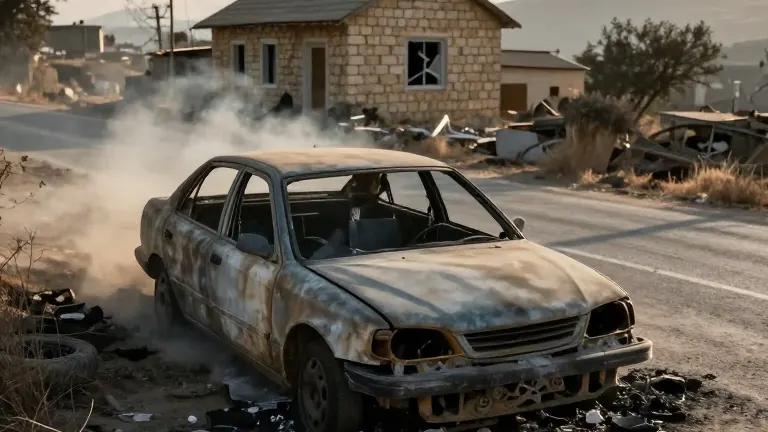
Zeinab Faraj, a 21-year-old photojournalist, survived a missile strike in southern Lebanon that killed her colleague, Amal Khalil. The attack occurred on April 22, one day after Israel and Lebanon agreed to a ceasefire following a month of intense airstrikes. Faraj was documenting the war's aftermath in the village of al-Tiri when the first projectile struck the car ahead of hers.
The strike killed Ali Nabil Bazzi, a 27-year-old municipal official, and Mohammed Hourani, a 37-year-old friend of the mayor. Both men had joined the journalists by chance at Tebnine governmental hospital that morning. Faraj and Khalil, a 42-year-old newspaper reporter, were not initially injured by the first missile. However, they were struck a second time while attempting to flee the burning vehicle.
Faraj described the moment the second missile hit as they tried to get back into their car. Both women were thrown backward, with Khalil wrapping her arms around Faraj. They took shelter in a nearby house to avoid low-flying drones. Khalil sustained visible injuries to her face, hand, and leg. Faraj sent a final message to her sister before her phone battery died, writing, "There's no hope left. Forgive me."
While inside the building, a drone descended toward Faraj, causing her to retreat to a bathroom floor. A subsequent missile impact trapped her under rubble. She remained unconscious until a paramedic reached her, clearing the debris while another drone dropped a stun grenade. Faraj was pulled from the wreckage and transported to a hospital.
Khalil died approximately one hour after paramedics were allowed to re-enter the area to rescue Faraj. At the hospital, nurses initially reassured Faraj about her colleague's condition before falling silent, signaling Khalil's death. The Israeli military stated the attack targeted saboteurs violating the ceasefire. Human rights groups labeled the incident a war crime, noting that the military received repeated messages urging a rescue operation while the women were trapped.
Tensions had risen in the weeks prior to the strike. An Israeli military spokesperson had shared a video of Khalil on social media a week before the attack, describing her work as "terrorist media." Khalil also reported receiving death threats from Israeli numbers. The military's justification for the strike drew criticism given the recent truce.
Faraj is now preparing to return to university, where she is finishing a degree in radio and television. She continues to freelance as a videographer. Her injuries include a limp, visible marks on one hand, and facial trauma that affects the movement of one eyebrow. She reports waking at night screaming and feeling a sense of isolation.
The experience has left Faraj with lasting physical and psychological effects. She struggles with climbing stairs and remains on edge when hearing aircraft. She is haunted by the image of Hourani lying on the ground after the initial strike, with his eyes open. Faraj continues to document the region despite the uncertainty of returning to frontline coverage.
Source: The Guardian