NASA details three-rocket sequence to test commercial moon landers
A 14-day mission will verify Blue Origin and SpaceX vehicles in Earth orbit before astronauts attempt a lunar landing in 2028.
By Giovanni Serrano ·
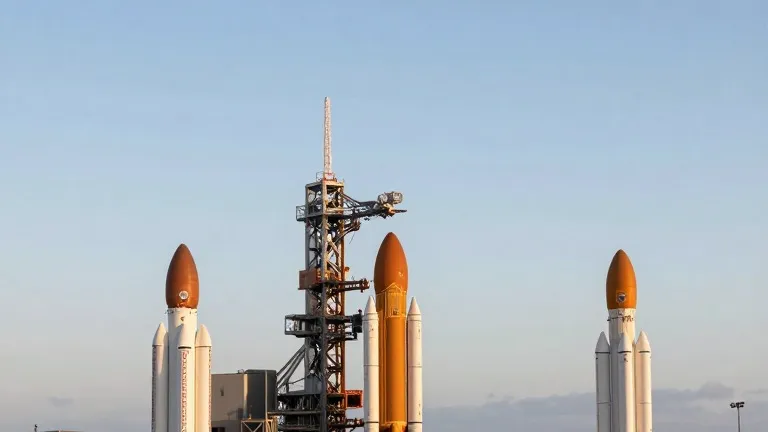
NASA officials outlined a complex orbital test campaign on Friday that will evaluate two separate commercial lunar landers before any crewed moon landing. The plan requires three rocket launches and a 14-day mission to verify hardware in low Earth orbit. Program manager Jeremy Parsons described the operation as likely the most complicated launch campaign ever undertaken.
The agency has previously tested lunar hardware through the uncrewed Artemis I mission and the crewed Artemis II flyby in April. Those missions did not include a landing or a long-duration dock with a commercial lander. The new Artemis III mission serves as the final gate before astronauts touch down on the moon's surface.
The sequence begins with Blue Origin's New Glenn rocket launching the Blue Moon lander into low Earth orbit. NASA's Space Launch System follows, carrying four astronauts to an elliptical orbit. The crew, which includes NASA's Randy Bresnik, Andre Douglas, and Frank Rubio, plus ESA's Luca Parmitano, will then spend two days checking Orion systems. They will meet Blue Moon on Flight Day 3 at an altitude of 273 miles.
During the docked period, astronauts will enter the lander to test environmental controls and life support. Mission Control will also test emergency procedures and dual-vehicle control. Around Flight Day 6, SpaceX's Starship will launch with a special docking adapter. The vehicle will meet Orion on Flight Day 8 for a two-hour encounter where the crew will not enter the craft. This step will measure docking forces and how the vehicles interact.
After undocking from Starship, the Orion capsule will remain in orbit for six to nine more days. The nominal mission length is 14 days, though it could extend to 17. The crew will evaluate survival suits, a task not completed during the 10-day Artemis II flyby, and conduct health assessments. The mission will end with a parachute-aided ocean splashdown.
NASA Administrator Jared Isaacman stated that the agency is preserving options for the 2028 Artemis IV mission. He said, "We have no intention of surrendering a viable path to the surface before the data and schedule compels us to do so." Both providers are planning lunar landing missions in 2028. With Blue Origin, Orion would meet the lander in lunar orbit. With SpaceX, Starship would dock with the capsule in Earth orbit and propel it toward the moon.
The launch date for Artemis III remains uncertain. NASA is targeting the summer of next year. However, Isaacman told employees in an internal memo last month that the mission was about 90 days behind schedule. Parsons cited the lunar lander supply chain as a major challenge. He and Isaacman both expressed confidence in resolving the issues. Isaacman added, "We're moving with real speed and purpose right now."
Source: Space.com